Success Feed
Student Experience
Homepage
Alumni Success

While Artemis II is making history in space, six BW students are preparing for their own NASA launch that is seven months in the making. And while they won't need a rocket ship to achieve their goal, they'll be at the forefront of lunar and Martian exploration.
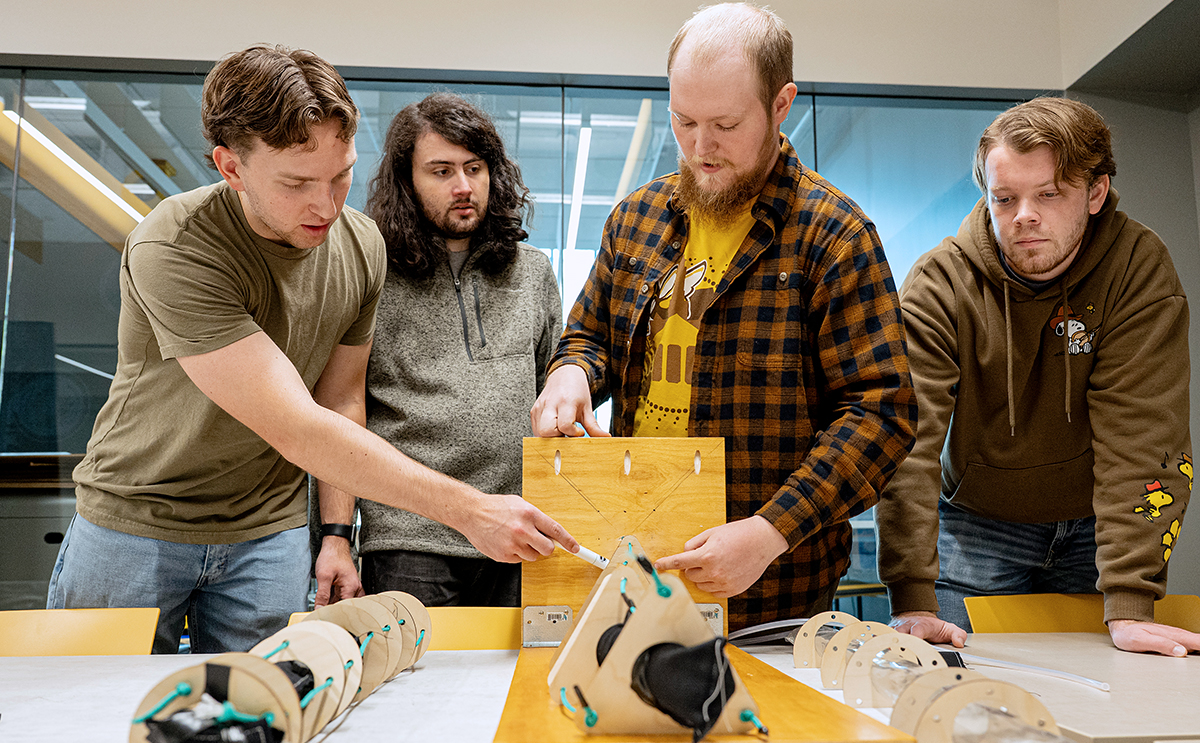
(l-r) Mike Rodak, Charlie Woods, Zach Mihok and Sam Gerber conduct a proof-of-concept experiment to see what characteristics can be implemented in the final solution.
In June 2025, BW was one of 10 schools nationwide to be accepted into the National Space Grant Foundation's Moon to Mars eXploration Systems and Habitation (M2M X-Hab) 2026 Academic Innovation Challenge.
Sponsored by NASA's Mars Campaign Office, the M2M X-Hab Challenge requires student teams to go through a series of NASA-standard assessments as they develop space technologies in collaboration with NASA researchers. The prestigious honor, which included a competitive proposal process, is benefiting students in engineering.
As a NASA award recipient, BW received funding as well as an opportunity to design, build and test a prototype of a lightweight tunnel system that could be used on a lunar and/or Martian surface to connect elements such as habitats, rovers, logistics carriers or landers.
For the six students involved and their two professor mentors — Drs. Jeff Dusek and Jonathon Fagert — the NASA challenge is providing exceptional, real-world focused learning.
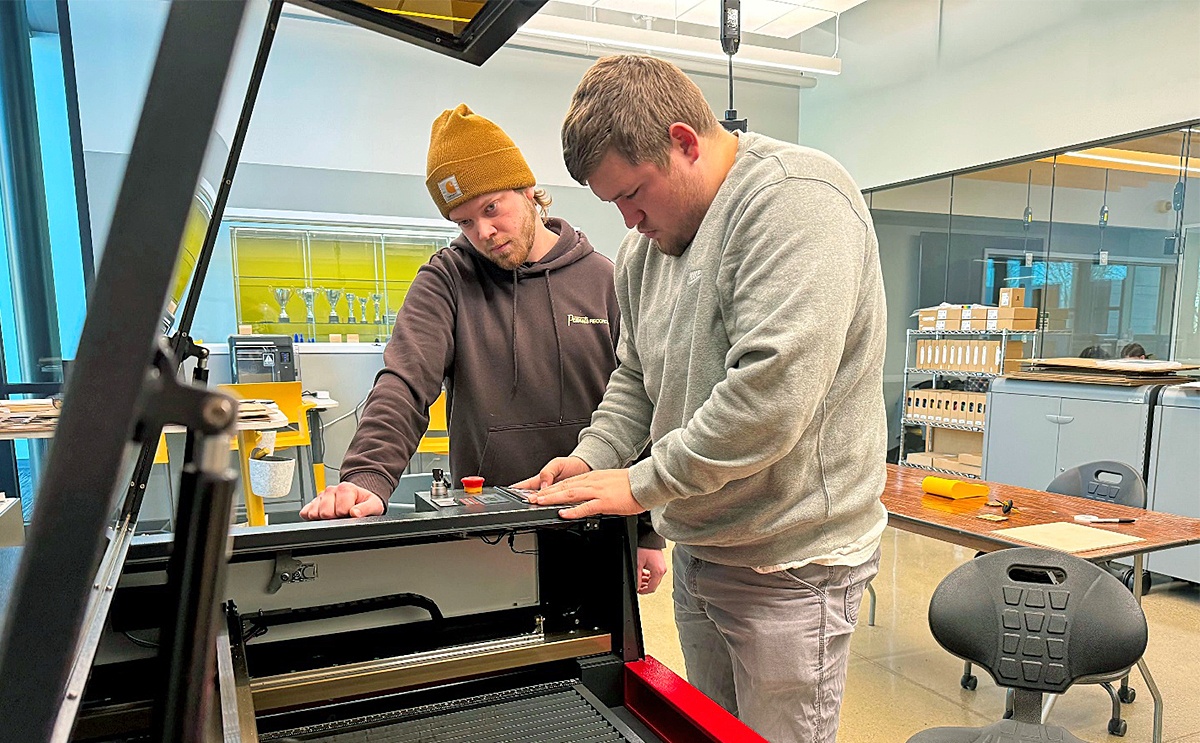
"Our challenge is to innovate or create a system that allows space personnel to travel and transfer materials from one habitat to another without having to wear a space suit," explained Mike Rodak '26, an engineering student from Medina, Ohio.
"Because NASA wants to avoid permanent structures on the moon's surface, our tunnel system has to be able to extend when in use and retract when not in use," he added. "It also has to be pressurized, so it is habitable for humans."
The BW student team began work in the fall semester as part of a year-long capstone course, led by Dusek and Fagert, that included Rodak and other seniors Sam Gerber, Zach Mihok, Ciaran Smith, Alex Smith and Charlie Woods. Today, as they near the early May deadline for their final report to NASA, the group feels confident in their prototype.
"With a project like this that is open-ended, we have been able to really expand our knowledge as well as possible solutions to be as creative and innovative as possible," said Rodak.
"The challenge allowed us to research new techniques and technologies while also providing opportunities to build skills in communication, both within the team and for public speaking for presentations," he remarked.
"This is the first experience many group members have had with a project of this magnitude. Drs. Dusek and Fagert wanted this to be both a culmination of what we learned throughout the engineering program as well as an experience to open up new learning pathways," he stated.
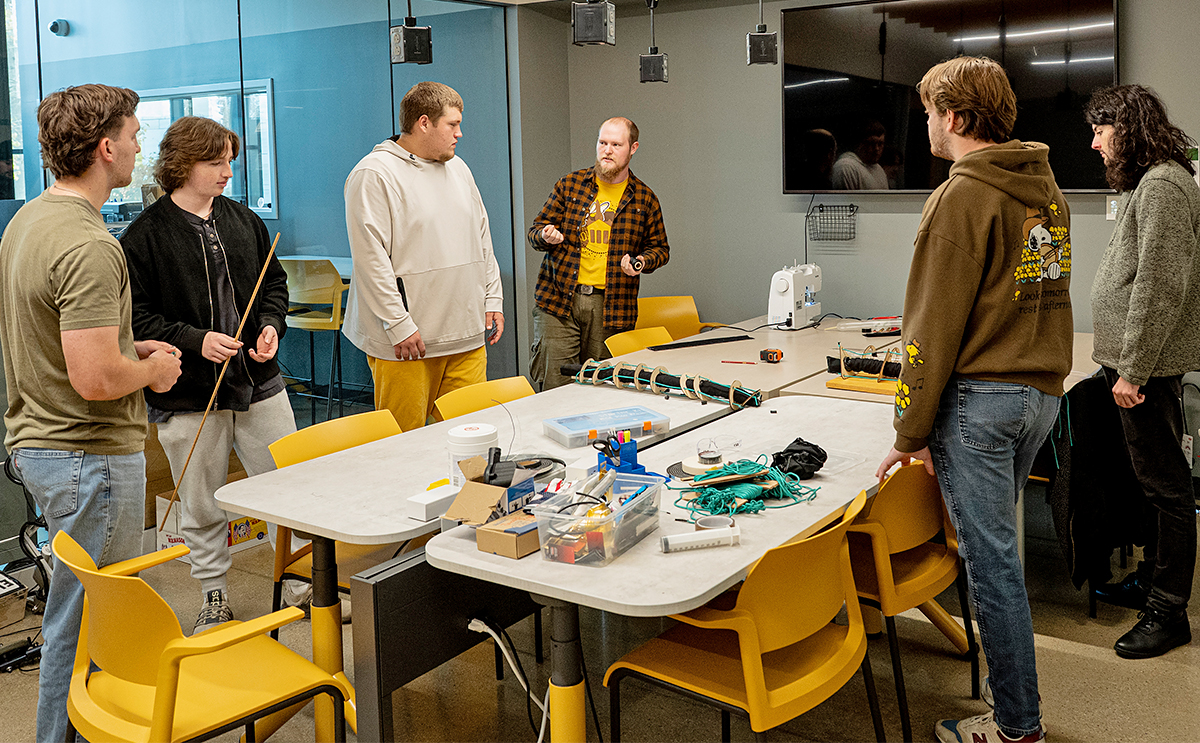
"The NASA challenge is an excellent example of providing BW engineering students with externally engaged capstone experiences that are on par with much larger engineering programs," said Dusek, who helped write the proposal that secured BW's entry into the NASA program.
"External funding means that students can have the resources to purchase specialized equipment and build and test multiple physical prototypes. Each funded project allows our students to demonstrate their creativity and technical skills, providing proof points that enhance the competitiveness of the next grant proposal or industry partnership," he emphasized.
Dusek went on to say that for this project, BW will leverage its affiliation with the Aerozone Alliance network to partner with Cleveland-based National Safety Apparel (NSA) for its expertise in textile engineering and manufacturing.
According to Dusek, NSA is the nation's largest manufacturer of American-sewn safety apparel. "While it might seem strange to partner with an apparel company, our project with NASA is to build textile-based inflatable tunnel elements for use on the Moon and Mars, so NSA's expertise in textile engineering and protective fabrics is a tremendous asset."
He noted that the BW student team is also collaborating with Sobstad Sails, a local company with industrial cutting and sewing equipment, to help them develop prototype tunnel elements.
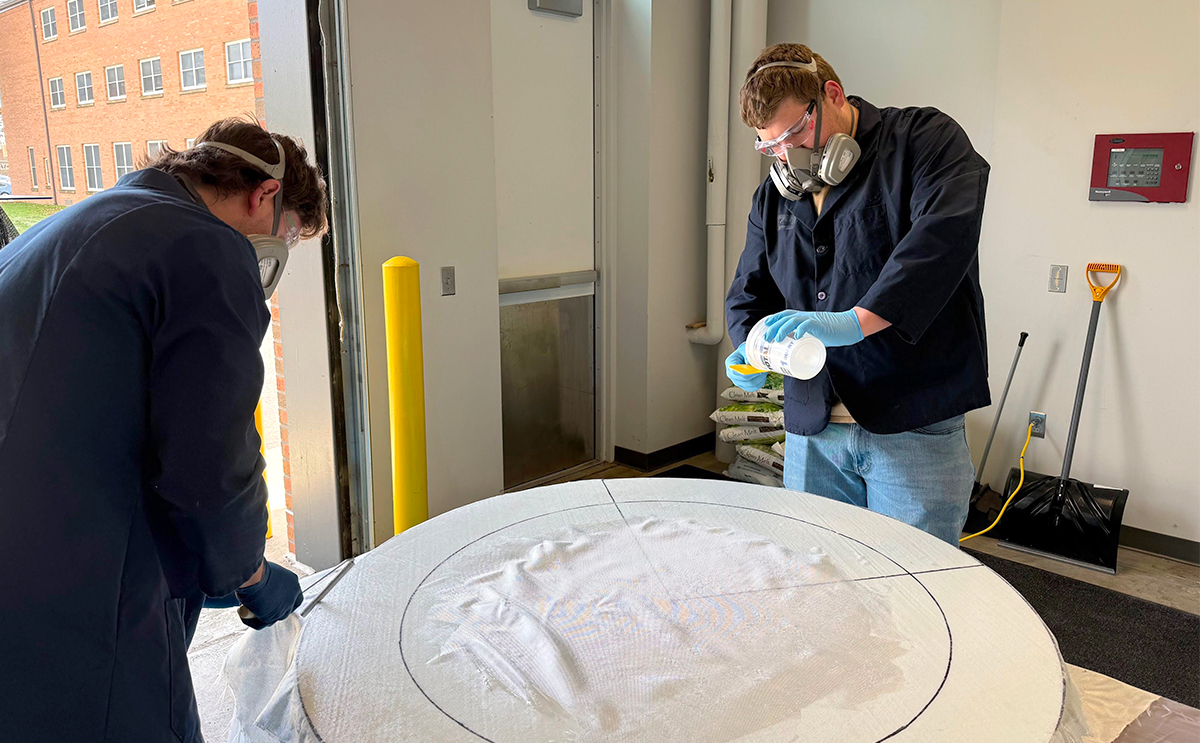
For the student team, the project has been everything they hoped it would be. For Alex Smith, it has been a dream come true because his goal is to work for NASA.
"I hope to gain a lot of insight on how NASA operates these projects, which, so far, I have been able to do because they have given us outlines and presentations," said the Parma, Ohio, resident.
Faculty-student mentoring has been a huge part of the project. Smith described the opportunity as invaluable.
"Honestly, this is my favorite part of the project. I love being able to pick apart the brains of our professors. This is a game-changer because we have two people (Dusek and Fagert) who are super experienced and have different engineering backgrounds. They are great to bounce ideas off of and to show us how to create professional presentations," he articulated.
For the student team, the project completion aligns with their last weeks of school before graduation. Through the NASA project, they gained invaluable experiences they can talk about with potential employers and confidence in their abilities of problem-solving, strategic thinking and innovation.
"I think this project is important for NASA and space travel because projects like this push the limit of what people can imagine. For students like us, who have been involved with the challenge, it has enabled us to put our skills and what we learned to the test," emphasized Rodak.
BW's student-focused approach to learning makes the university an outstanding choice for studying engineering. Students graduate with the knowledge and skills to succeed in their first job as well as subsequent managerial roles.
In 2023, BW earned accreditation by ABET (Accreditation Board for Engineering and Technology) on its initial application review.
The engineering program is part of BW's Choose Ohio First STEM Scholars Program, which includes a scholarship opportunity for eligible participants.