


Fullmer Arboretum
Founded in 1919, the Fullmer Arboretum has served Baldwin Wallace University for more than a century as a place for teaching and exploration.
Established by Edward L. Fullmer, professor of botany at BW from 1903 to 1940, the historic arboretum is bounded by Fifth Street, Bagley Road, Front Street and Beech Street. Its educational and stewardship mission now extends across the BW campus.
Today, the arboretum serves as a living laboratory where BW students and faculty study plants, environmental change and campus stewardship.
Mission
The Fullmer Arboretum supports BW's educational mission through a diverse plant collection and opportunities for field-based teaching, research, conservation and sustainability.
In 1958, BW biology professor Donald Dean described the arboretum primarily as a teaching resource, emphasizing purposeful plantings, native species, natural areas and active use by students and faculty. Those principles continue to guide the arboretum today.
A Living Laboratory: Tracking BW's Trees Over Time
In 2016, Baldwin Wallace mapped and inventoried more than 1,500 campus trees representing 107 species, establishing a baseline record that helped support BW's 2016 and 2017 Tree Campus USA recognition.
Beginning in 2026, BW students and faculty began remeasuring trees within the historic Fullmer Arboretum, allowing the same trees to be followed roughly a decade later.
Because each tree has a permanent identification number, the resurvey creates a longitudinal dataset for studying growth, canopy development, tree condition, species differences, and responses to the campus environment.
The project also supports student research while providing information that can help guide future campus stewardship.
Explore BW's Campus Trees
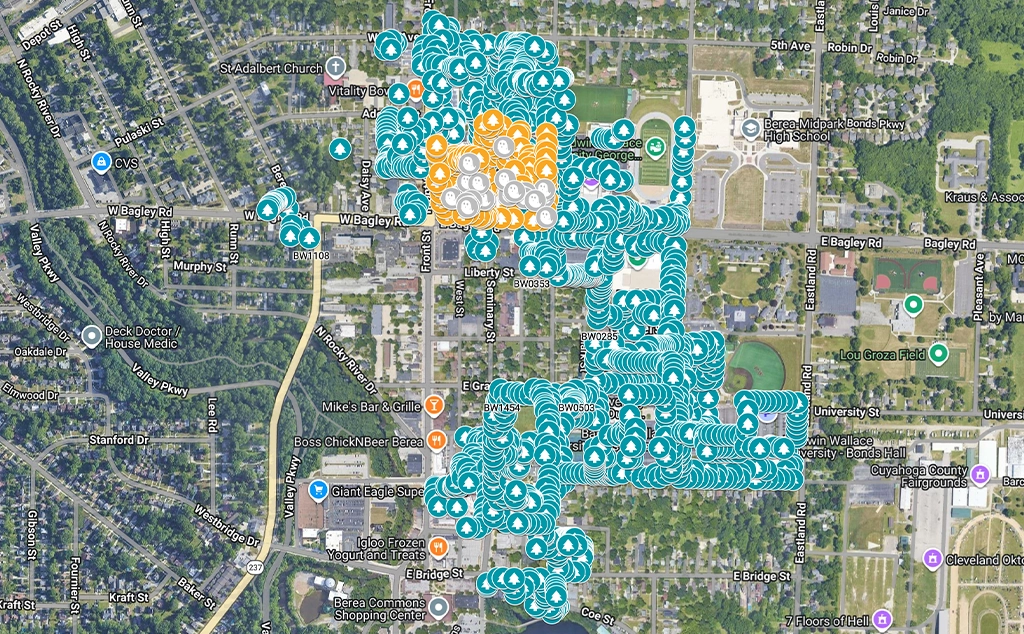
Explore more than 1,500 trees from BW's 2016 campus inventory on an interactive map. Teal tree icons show trees from the original inventory, orange tree icons identify trees remeasured in 2026, and gray ghost icons mark trees that are no longer present.
The Arboretum and Campus Tree Collection
The 2016 inventory documented the diversity of trees across the Fullmer Arboretum and broader BW campus.
At the time of the 2016 inventory:
- More than 1,500 trees representing 107 species were documented.
- Eight oak species were represented.
- Approximately 53% of campus trees belonged to species native to Northeast Ohio.
- Red maple was the most common species.
Notable trees include dawn redwoods, Corsican pines, a blight-resistant American chestnut hybrid and a historic osage orange. The bur oak on North Quad has been recognized as a Great Tree of Berea, and a native plant garden provides habitat for pollinators.
Teaching and Student Research
Students use the arboretum to study plant identification, tree growth, urban ecology, plant health, environmental stress, canopy structure, biodiversity, and carbon storage while participating directly in field-based research.
Long-term records support class activities, independent projects and collaborative research that can extend beyond a single laboratory period or semester.
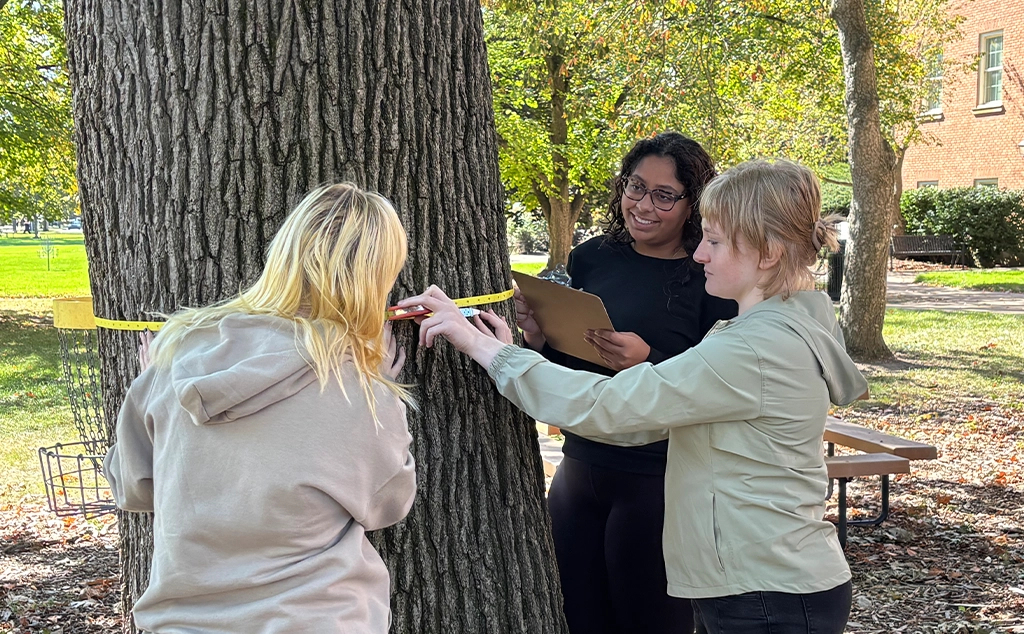
Students in Baldwin Wallace's Botany course measure a campus tree as part of ongoing arboretum inventory and tree research projects.
Get Involved
BW Students
BW students can participate in tree research, field activities, conservation projects and other campus landscape opportunities.
Alumni and Friends
Alumni and friends can support tree care, plantings, labels and signage, gardens, memorial plantings and student projects through the Campus Landscape Fund.
Campus Stewardship
Stewardship of BW's campus landscape is a collaborative effort involving Buildings & Grounds, faculty, and students.
Questions
Questions about the arboretum, tree care or opportunities to become involved can be directed to associate professor Aaron Smith at asmith@bw.edu.